


The last official census in 2011 set the population of Slatina-Timis at 3074 inhabitants, 75 less than the previous census in 2002. Earlier the decrease was much more pronounced: after the revolution most of the ethnic German-Bohemian inhabitants left Sadova Veche (Alt Sadowa) to return to Germany. In 1977 it was still a closed German community: 522 Germans and only 61 Romanians.

The current ethnic demographic is approximately:
- Romanian 93%
- German 2.5%
- Roma 2.5%
- Other 2%
The distribution of faiths:
- Orthodox 60% Baptist's Church of Sadova Noua
- Roman Catholic 30%
- Baptist 5%
- Other 5%
The Roman Catholic faith:
It is remarkable that in an otherwise almost entirely orthodox environment almost half the inhabitants of the main village are Roman Catholic. There has been quite some research done to explain this fact. There are several reasons to believe this is not due to Hungarian influence. After the Ottoman invasion in 1716 there are reports that a Hungarian community capitulated and settled in Slatina-Timis. Professor Zeicu has debunked this explanation on the basis of a study of surnames. The Roman Catholic population all has typical Romanian names. Doubt has also been cast on the idea that a portion of the community converted to Catholicism under Austrian pressure during a later period of religious unrest (1731-1771). There are surviving manuscripts from the Roman Catholic parish that pre date that period. Professor Zeicu concludes that the Roman Catholics descend from the Vlachs, a Romanian-speaking people from Bulgaria. The Vlachs converted to Catholicism around 1200 AD during the time of Pope Innocent III. During Turkish invasions they crossed the Danube. 250 families, 2000 souls are thought to have settled in Slatina-Timis in 1526.
Gugulans:
…was the name given to the farmers around Slatina-Timis. They cultivated fruit on the hills, usually apples. Typically covered carts were used to transport the goods which were sold throughout the entire Banat region each autumn and winter. The lifestyle was relatively primitive, insular. Even though business was good this was not apparent from their properties but could be seen by the gold coins worn around the necks of the woman and daughters of the community.
Work:
Most residents of Slatina-Timis were poor.
The farming land was not very productive, this was also the reason why the land was not collectivised during the Communist period. Many families were engaged in subsistence farming on their own allotments. Many also owned cows, pigs, sheep, geese and chickens. The largest farms owned a dozen cows.
Forestry also provided an income.


There were large lumber mills.

Additionally there were tradesmen, artisans, journeymen and smiths.
The Roma are particularly talented in artistic undertakings such as painting, plasterwork and metalwork.
For jobs in other industries it was necessary to travel: Caransebes had lost its furniture industry and metal works (producing train axles) in the meantime. The workers sought employment in the blast furnaces and foundries of Otelu-Rosu and Resita. Most companies closed one by one after the revolution. Caransebes was able to attract new employers, amongst others producing car parts. Many of the younger generation sought opportunity in the more prosperous Western Europe, America and Canada. This explained the reducing population figures and the collapse of the property market in the main cities.


In December 1989, after the removal of Ceausescu from power, Geel adopted Slatina-Timis, as can still be seen from the signs posted at the entry to the city limits.
In 1992 the cooperation was made official and the towns were twinned.
The councils of Geel and Slatina-Timis sign the twin town agreement. 2 years later this takes on the definitive structure of a non-profit organisation shared between the city of Geel and the Geel Romanian Committee.
EUROFEESTEN

In 2002, 2007 and 2012 enthusiastic teams from Slatina-Timis participated in the ‘Eurofeesten’ (Euro parties) in Geel. Especially the dancers were very well received each time. Representatives of the council also travelled to join in. The visitors were accommodated during their stay by host families.
EUROST: 20th anniversary celebration of the cooperation with Slatina-Timis: 5-9 August 2010
In spite of the widespread flooding and resulting damage in Slatina-Timis in July 2010, the EUROST event still took place in August, albeit with somewhat dampened spirits


This time representatives from the Geel city council stayed in host families from Slatina and (again) enjoyed their renowned hospitality.
 Slatina-Timis covers an area of 15,109 hectares situated in the valley of Timis and Cerna at an altitude of 350m. The railway line Bucharest-Timisoara crosses the area as does the DN 6 (E70) motorway.(google-map -route)

Neighbouring Slatina-Timis we find the provincial capital Resita (60km), Caransebes (20km), Baile Herculane (60km), Mount Semenic (30km), Trei Ape (20km) and Muntele Mic (42km).
The borough consists of a village centre and 3 hamlets: Sadova Veche, Sadova Noua and Ilova. The village centre and Sadova Veche are situated in the valley, while Ilova and Sadova Noua are located in the surrounding hills..


Sadova Veche

A European project involving the municipality and the EU secured waterworks in Sadova Veche. A pumping station was constructed and the properties were connected to the mains water complete with water meters.
Slatina-Timis Centrum
During the first project organised by the Geel Romanian Committee in 1992 each household was connected to the mains supply. The metal mains pipes were paid for by the Romanian government. The connecting pipes paid for by the committee were made of high density polyethylene (HDPE socorex tubes). 

In 2012-2013 the rust damaged mains pipes in Slatina-Timis were replaced with HDPE pipes by the local authorities. Water meters were also installed at each home.
Previously the water catchment was centered on the mountain river. During periods of heavy rain silt made its way into the pipes causing water discoloration and clogging the water filters. Today 2 catchment areas split the village centre. One half receives water from boreholes drilled along the way to Trei Ape. This water is collected in a reservoir and is siphoned to the households from there.


Similarly the other half of the village is supplied by a borehole close by the forest road to Secas, again water is collected in a reservoir before being siphoned to the households.
Close by the village square in Slatina-Mic an electric pump indicates the position of a borehole.
Slatina-Timis has a separate system for waste water: rainwater and sewage water. The waste water system was renewed at the same time as the mains water.


Finally, the roads received a service and a new layer of asphalt where needed.
Ilova
The local authorities have submitted plans on several occasions to the EU for support to connect Ilova to the water mains, so far without success.
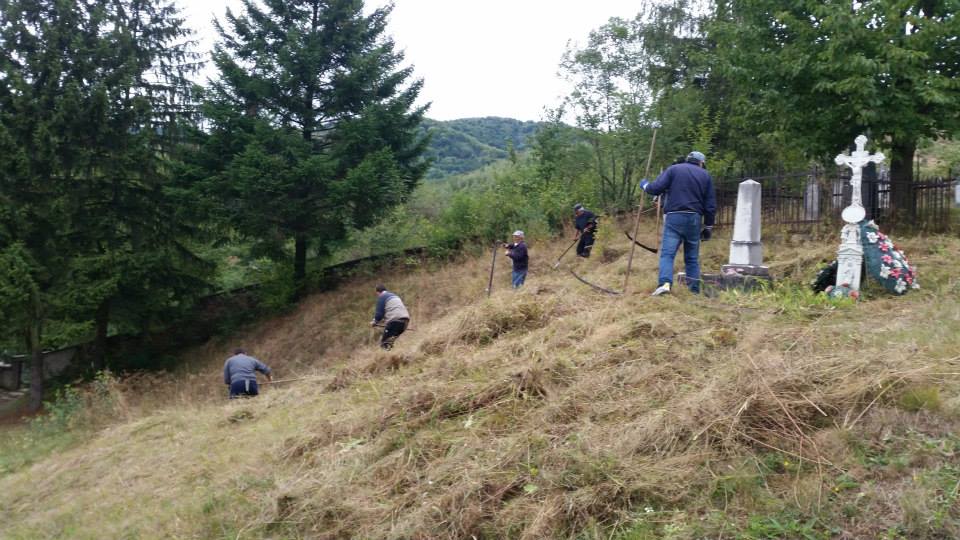
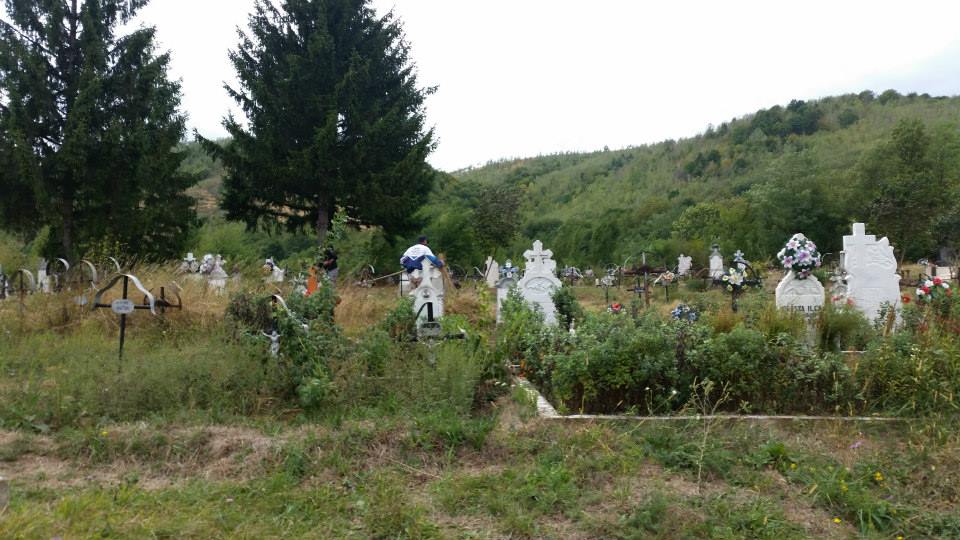
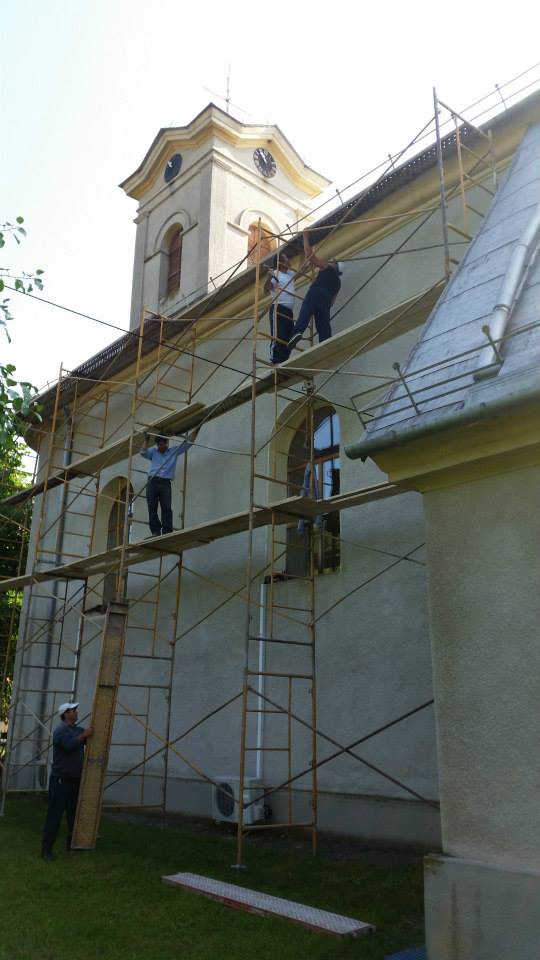
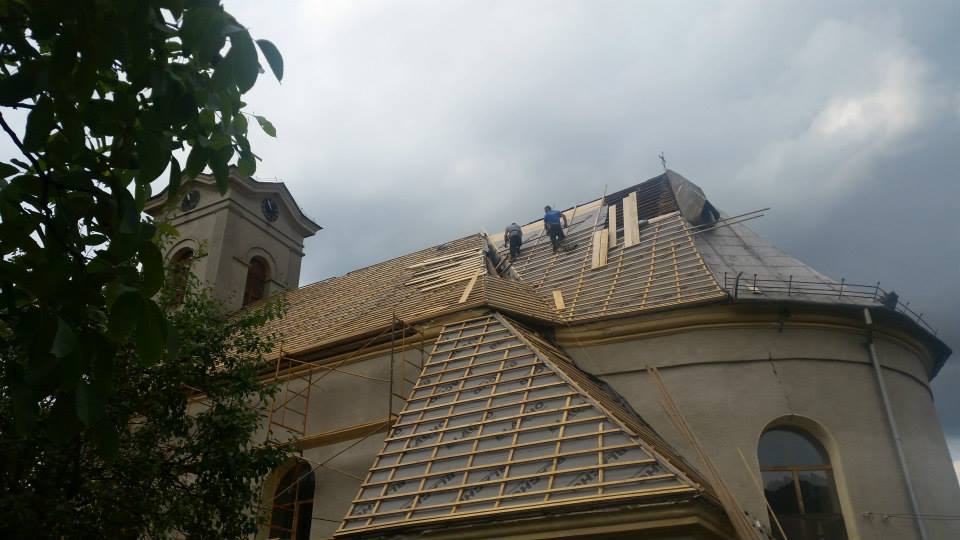
The roof of the catholic church is renewed. On the Catholic cemetery grass has been cut.
More about the catholic church: click here

Subcategories
Organisations
In Slatina-Timis it is not easy for associations. Many men and women are working abroad and young people are studying in cities like Timisoara and Resita, far from their village. The youth movement GLT Golden Hearts is currently the most active association. Both the women's and men's movement require a younger and more dynamic board.
Beside the nursing core, there is the absence of a "senior association", the older people who, in many cases take care of their grandchildren, remain in the villages. Now there is no younger generation to take care of them in their old days as it was the custom, not only in Slatina-Timis, but all over Romania.
Outside this association, there is also a football team A.S. Timisul Slatina-Timis Asociatia The field is located beside the Timis at the entrance of Slatina-Timis center. In August, an annual mini-soccer-street competition is held on the artificial turf, laid out on the playground of the school with European subsidies.
Fire Brigade
In Sadova Veche, an hamlet of Slatina-Timis, the fire brigade exists already more than 100 years.
In recent years, the activities were minimal. In 2006 Geel donated a fire truck to Slatina-Timis. It took a lot of time to form a fire brigade of volunteers. After the 2012 elections a corps was formed with 15 volunteers led by Councillor Anton Gruber.
They are training regularly. They have done a few interventions in case of fire or flooding. The Committee of Geel took care,in cooperation with the professional fire team of Geel, of the equipment: both material as clothing . Cooperation with the professional corps of Caransebes is running smoothly.
